
Strength Training for Women: A Beginner’s Guide That Makes Sense
Oct 05, 2026Most women who come to Bodyfit Mums are perfectly capable of working hard.
The problem is rarely a lack of effort.
They may have spent years doing fitness classes, following YouTube workouts, running or trying to burn as many calories as possible. Yet structured strength training can still feel like unfamiliar territory.
Which exercises should you do? How heavy should you lift? What if your technique is wrong? Are three workouts enough? Should you feel sore afterwards?
When you don’t know the answers, it is easy to keep doing what feels familiar—or jump between random workouts without knowing whether you are progressing.
After almost 10 years of coaching women, we know that beginners don’t need a complicated programme or a house filled with equipment.
They need a sensible starting point, clear guidance and enough time to become confident.
This guide will help you understand what strength training involves and how to begin at home.
What is strength training?
Strength training is any exercise that asks your muscles to work against resistance.
That resistance could come from:
-
Dumbbells
-
Kettlebells
-
Resistance bands
-
Your own body weight
-
Everyday objects used safely at home
You might also hear it called weight training or resistance training. Although the language varies, the general aim is the same: to gradually improve your ability to produce force and handle physical demands.
A strength session does not have to involve extremely heavy weights or complicated exercises.
A squat to a chair, a resistance-band row or a dumbbell deadlift can all be strength exercises when they provide an appropriate challenge.
Why is strength training important for women?
Strength training can improve muscular strength, physical function and confidence in what your body can do.
That can show up inside your workouts, but it also matters in everyday life.
It might mean:
-
Carrying shopping without struggling
-
Lifting your children or grandchildren
-
Feeling steadier and more capable
-
Moving furniture without immediately calling for help
-
Completing a hike, run or HYROX event
-
Maintaining strength as you get older
-
Seeing progress that has nothing to do with the scales
For many women, strength training also changes their relationship with exercise.
The focus begins to move away from simply burning calories. You start noticing that you can lift more, complete an exercise with better control or do something that felt impossible a few months ago.
Those wins matter.
“But I don’t want to get bulky”
This is one of the most common concerns we hear from women beginning strength training.
You will not suddenly build large amounts of muscle because you picked up a heavier dumbbell.
Noticeable muscle growth requires consistent training, progressive overload, adequate nutrition and time. It does not happen accidentally after a few strength sessions.
Strength training may help you build or maintain muscle and change how your body feels and functions. Exactly how your body responds will depend on your training, nutrition, genetics, recovery and starting point.
You remain in control of how you train and what you are working towards.
How often should a beginner strength train?
At Bodyfit Mums, we recommend starting with three strength sessions each week.
Three sessions give you enough exposure to practise the main movements regularly, train the whole body and begin progressing - without exercise needing to take over your week.
Your routine might look like:
-
Monday: Strength session
-
Wednesday: Strength session
-
Friday: Strength session
This leaves recovery time between workouts and can be adapted around work, children and other commitments.
Some weeks, life may mean you only complete two sessions. That does not make the week a failure.
Return to your usual three-session rhythm when you can.
Consistency across several months matters far more than completing every individual week perfectly.
What exercises should a beginner programme include?
You do not need dozens of different exercises or a completely new workout every week.
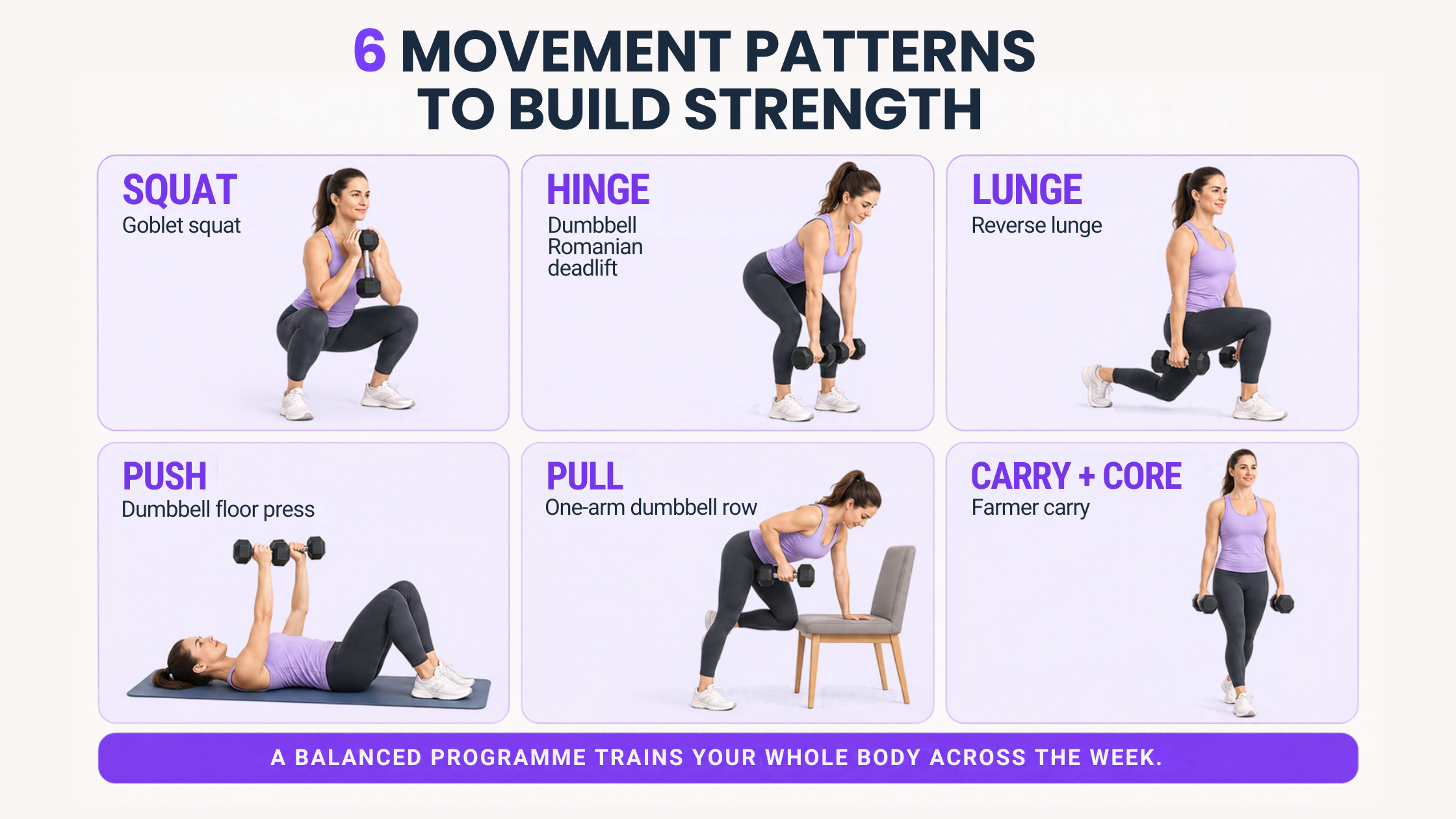
A well-rounded strength programme will usually include a mixture of:
- Squat: such as a chair squat or goblet squat
- Hinge: such as a dumbbell Romanian deadlift
- Lunge: such as a reverse lunge or split squat
- Push: such as a floor press or shoulder press
- Pull: such as a resistance-band or dumbbell row
- Carry or core work: such as a farmer carry, dead bug or plank variation
You won’t necessarily complete every movement in every session.
What matters is that your programme trains the whole body across the week and gives you enough repetition to improve your technique, strength and confidence.
How do you choose your starting weight?
Your first weight does not need to be perfect.
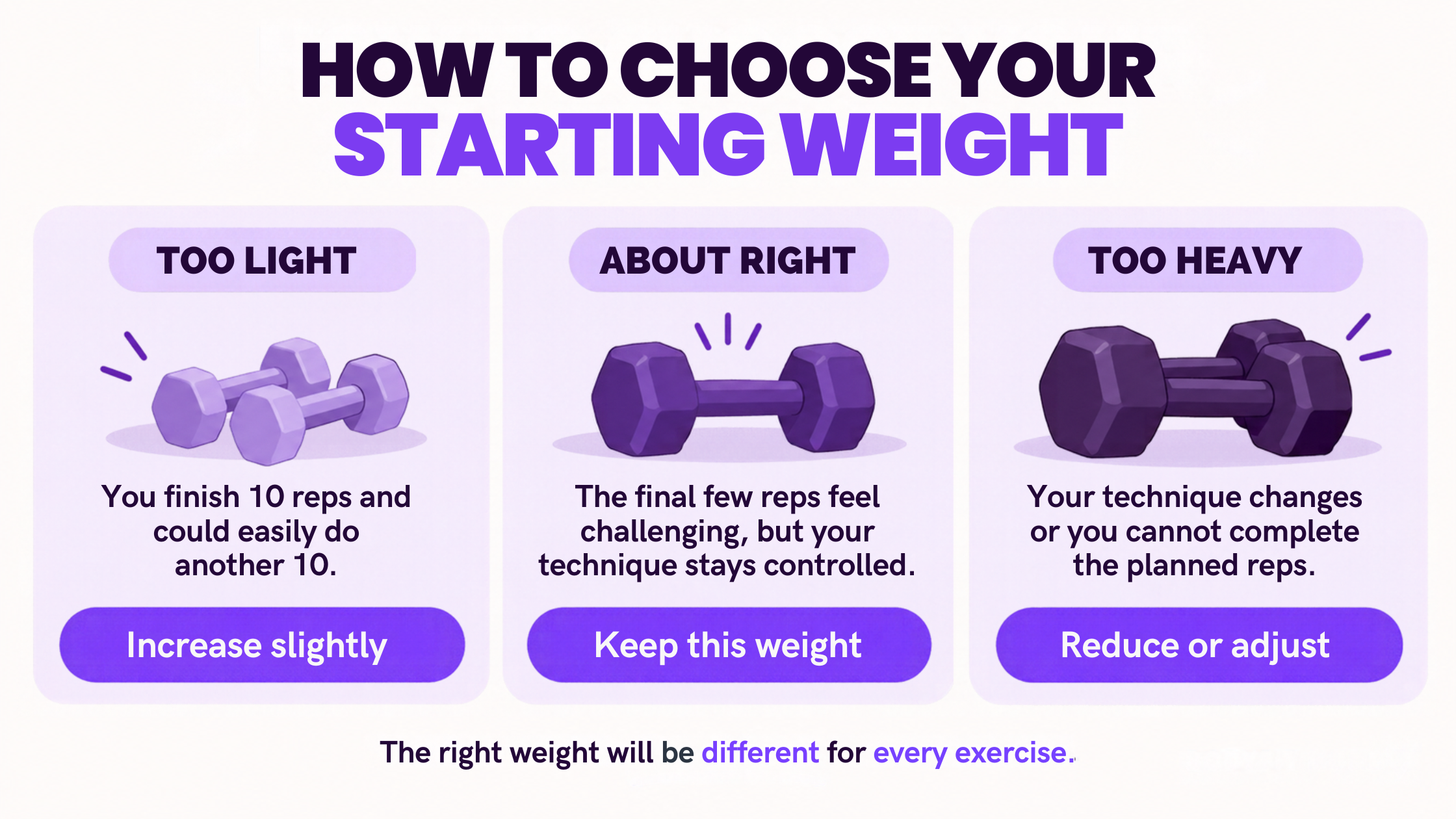
Choose a load that allows you to complete the exercise with control while still making the final few repetitions feel challenging.
For example, if your programme asks for 10 repetitions:
-
Repetitions one to five may feel comfortable
-
The exercise should become more challenging as the set continues
-
By repetitions eight to ten, you should need to concentrate
-
You should still be able to maintain good technique
If you finish the set and feel as though you could easily complete another 10 repetitions, the weight is probably too light for that exercise.
If your technique changes significantly or you cannot complete the planned repetitions, reduce the weight or adjust the exercise.
The right weight will vary from one movement to another.
You may be able to lift considerably more in a deadlift than in a shoulder press. That is completely normal.
What should a beginner workout look like?
A simple full-body session might include:
-
Goblet squat
-
Dumbbell Romanian deadlift
-
Dumbbell floor press
-
One-arm dumbbell row
-
Reverse lunge
-
Farmer carry
You could begin with two or three sets of each exercise and work within a comfortable repetition range.
The exact exercises, sets and repetitions should reflect your experience, available equipment, goals and any individual considerations.
A good beginner session should leave you feeling as though you have trained. It does not need to leave you unable to walk downstairs for three days.
Soreness can happen when you begin or introduce a new exercise, but it is not how we measure whether a workout was successful.
How does progression work?
Your body needs a reason to adapt.
Over time, that means gradually asking it to do a little more. This is often called progressive overload.
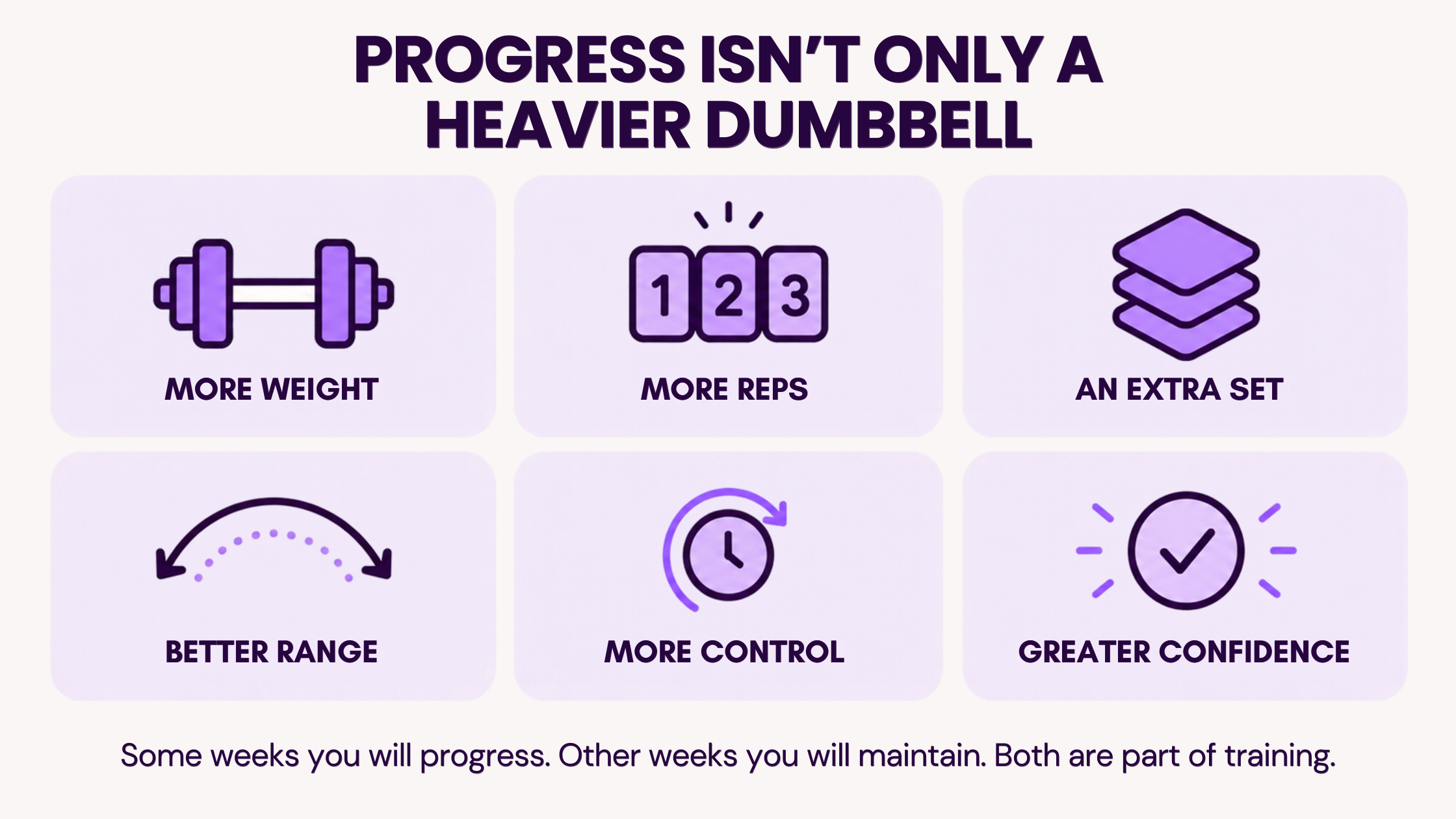
Progression might involve:
-
Increasing the weight
-
Completing another repetition
-
Adding a set
-
Improving your range of movement
-
Moving with better control
-
Using a more challenging exercise variation
-
Completing the same work with greater confidence
You do not need to increase your weights during every workout.
If you can complete all your planned repetitions with good control and feel that you could comfortably do several more, it may be time to try the next available weight.
Some weeks you will progress. Other weeks you may maintain what you are already doing.
Both are part of training.
Can strength training at home really work?
Yes. You can build strength and make meaningful progress at home with a small amount of equipment and an appropriately challenging programme.
Home training can be particularly useful when you are balancing exercise with children, work and family commitments.
It removes travel time, allows you to train in a familiar environment and makes it easier to fit a session into a busy day.
You do not need an entire home gym. Many women can begin with:
-
A selection of dumbbells
-
A resistance band
-
A mat
-
A small amount of clear floor space
As you become stronger, you may need access to heavier dumbbells or more challenging exercise variations. This is where a progressive programme becomes important.
Repeating the same workout with the same weights indefinitely will eventually limit your progress. Your training should develop as your strength and confidence improve.
What if you feel awkward exercising at home?
Starting at home removes the pressure of other people watching, but it can bring different uncertainties.
You may wonder whether your technique is correct, whether you are using enough weight or whether the session is really “counting”.
Keep your first few weeks simple:
-
Follow a clear programme rather than choosing random workouts
-
Learn a small number of exercises
-
Give yourself time to practise each movement
-
Record the weights and repetitions you complete
-
Ask for technique support when you need it
-
Repeat the programme consistently enough to see progress
You do not need to look polished or experienced.
You are learning a new skill, and confidence develops through repetition.
What beginners often get wrong
Changing the workout every week
Variety can be enjoyable, but constantly changing exercises makes it difficult to practise technique or measure progress.
Give your programme enough time to work.
Choosing weights that never feel challenging
Light weights can be appropriate when learning an exercise.
As your control and confidence improve, the resistance should gradually increase too.
Starting with an unrealistic schedule
At Bodyfit Mums, we recommend aiming for three sessions each week.
The important part is making those sessions work around the life you already have.
始化 Choose days and times that are genuinely manageable. If possible, decide when you will train before the week begins instead of hoping you will find time later.
Some weeks may not go exactly to planibele. Complete what you can and return to your usual routine without trying to compensate.
Using soreness as proof of progress
A successful session can produce very little soreness.
Track your weights, repetitions, technique and consistency instead.
Comparing your beginning with someone else’s middle
The woman you follow online may have been training for five years.
Her weights, exercises and progress have no relevance to where you should begin.
Your programme should meet you at your current level and develop from there.
What we have learned from coaching women
The biggest change rarely happens during the first workout.
It happens when a woman who once felt unsure opens her programme and knows exactly what she is there to do.
It happens when she stops automatically reaching for the lightest weights.
It happens when she realises that missing one session has not ruined anything and simply returns to her programme.
It happens when she becomes interested in what her body can do.
After almost a decade of coaching women, we have seen Blackjack that strength is built through ordinary weeks.
The sessions completed before work, between school runs, in the living room or while dinner is in the oven all count.
You do not need to think of yourself as a “fitness person” before you begin.
You become stronger and more experienced by starting.
Your simplest starting point
If you want to begin strength training, focus on these four things:
-
Aim for three structured strength sessions each week.
-
Learn a small number of core movement patterns.
-
Use weights that make the final repetitions challenging.
-
Record what you do so you can progress gradually.
You do not need to wait for the perfect programme, a quieter month or a sudden burst of confidence.
Begin with three manageable sessions, repeat the basics and give yourself time to learn.
Confidence usually arrives after you start, not before.
Would personalised support help?
Bodyfit Mums provides personalised online training, nutrition coaching, accountability and support for busy mums.
Our current strength programmes are designed to be completed at home, removing travel time and making training easier to fit around work and family life.
We take time to understand where you are starting, what equipment you have, what you want to achieve and what is likely to get in the way.
Your programme is then built around your experience, goals, family, career and real life.
If you want to begin strength training but still feel unsure about exercises, weights or where to start, send us the word STRONG by DM.
You do not need to write a long message or have everything figured out.
Start with that one word and we’ll take the conversation from there.
DM us “STRONG” on Instagram.
This article provides general educational information. If you have an injury, health condition, are pregnant or have recently given birth, seek appropriate professional advice before beginning a new exercise programme.